

Many commercial insurance customers across Canada are benefiting from a favourable market cycle, with stabilizing premiums creating valuable budget flexibility. Rather than viewing these savings solely as a financial windfall, forward-thinking organizations are seizing the opportunity to strengthen their long term resilience and operational performance.
By reinvesting premium savings into their physical assets, risk management strategies, and workplace safety culture, companies are enhancing risk preparedness, improving asset protection, and positioning themselves for sustained success in the years ahead.
“Risk control can sometimes slip in softer markets, but favourable conditions often give businesses more flexibility to invest in loss prevention. We know the hard market will always return. When it does, clients who took advantage of a softer market to strengthen risk management will be far better prepared to withstand future losses and navigate more challenging renewal conditions,” Chris Snider, Aviva Canada Manager with Aviva’s Risk Engineering and Advisory Services (REAS) Chris Snider told Canadian Underwriter magazine.
Here are some expert recommendations to help your organization make the most of the soft market.
Technical and market prices, explained
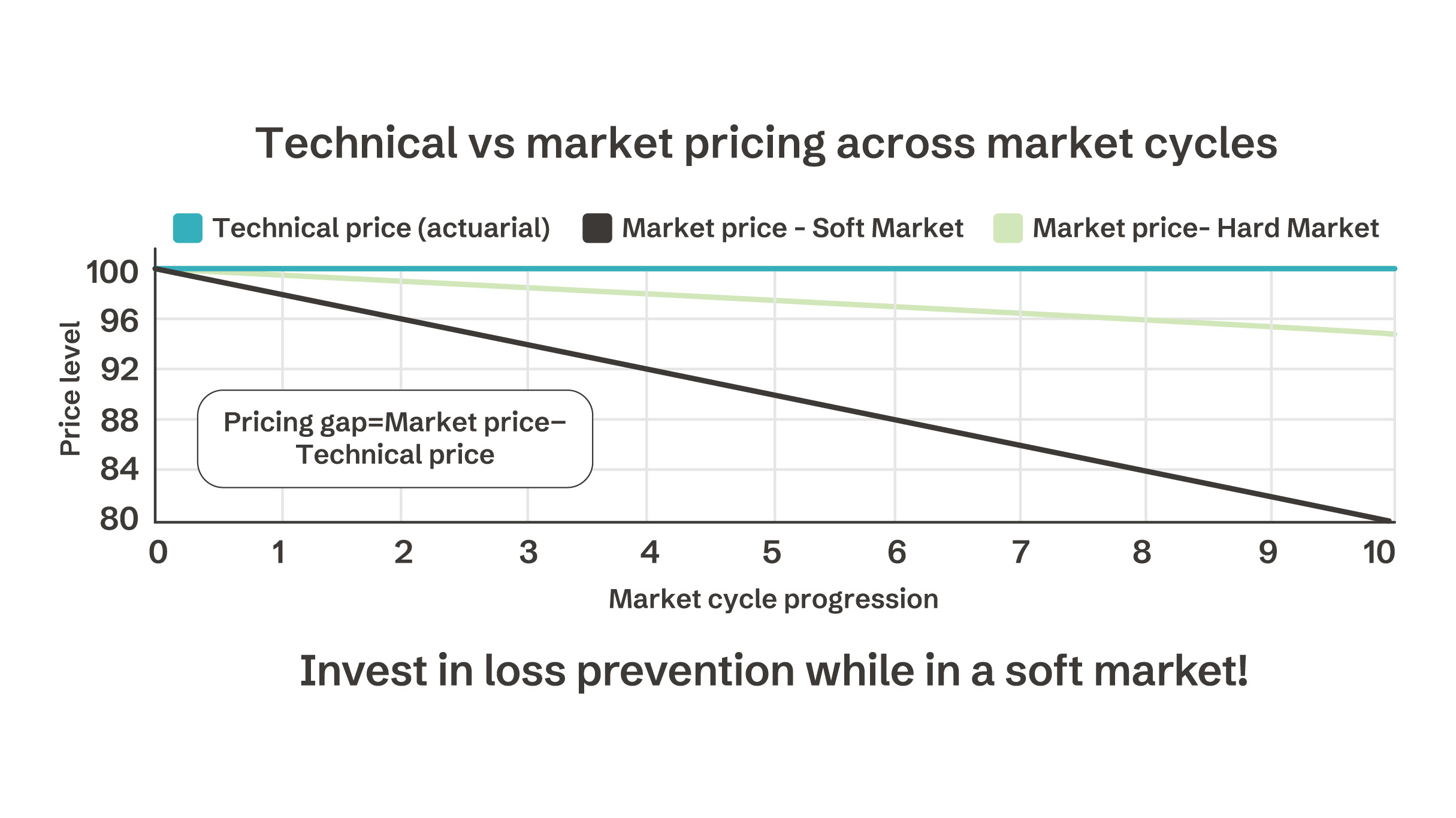
Understanding when and how to deploy this surplus capital requires a clear view of the economic mechanics behind insurance cycles. Actuarial science divides corporate property pricing into two distinct benchmarks: technical price and market price.
- Technical price is the actuarially indicated baseline. It represents the exact premium required to cover expected claims costs and achieve a targeted financial return, calculated purely on data, localized asset exposures, and objective underwriting assumptions.
- Market price reflects what the competitive landscape will actually bear. It fluctuates based on capital capacity, domestic and global competitor positioning, distribution strategies, and broader macroeconomic objectives.
Managing the market cycles
Actions
- Upgrade fire protection, cybersecurity controls, fleet safety technology, or equipment maintenance.
- Implement formal safety programs (training, audits, incident tracking).
- Address known loss drivers rather than deferring repairs or controls.
Hard‑market payoff
- Lower loss frequency/severity improves underwriting outcomes.
- Positions the business as a “preferred risk” when underwriters become selective.
- Reduces reliance on market pricing that may spike later.
As a soft market continues, competitive conditions can contribute to pricing that falls below long-term technical benchmarks, creating a temporary pricing gap. Over time, evolving claims trends may influence how insurers assess and price risk, resulting in future adjustments to premiums.
Whether this deficit manifests within a specific industry segment, a high-exposure line of business, or an entire commercial property portfolio, it can act as the primary trigger for a market correction. When market conditions shift, premium rates may increase and underwriting requirements can become more stringent.
Reinvesting premium savings to reshape the corporate profile
For sophisticated corporate entities—particularly those using high self-insured retentions, large deductibles, or captive insurance structures—the pricing gap provides an opportunity to review and refresh how they manage their total cost of risk (TCOR). Rather than viewing risk management purely through the lens of annual premium costs, TCOR incorporates capital expenditures, deductibles, third-party risk engineering services, and direct loss retentions.
Reinvesting soft-market premium savings back into a company’s infrastructure can act similar to improving a corporate credit score. Underwriters often view proactive capital improvement as a strong leading metric of account quality which can raise a company’s profile across the domestic marketplace. When a broker can deliver a verified testimonial showing that a client actively treats operational risk as their own liability—rather than simply offloading it onto an indemnity policy—it can elevate that business into a preferred risk category.
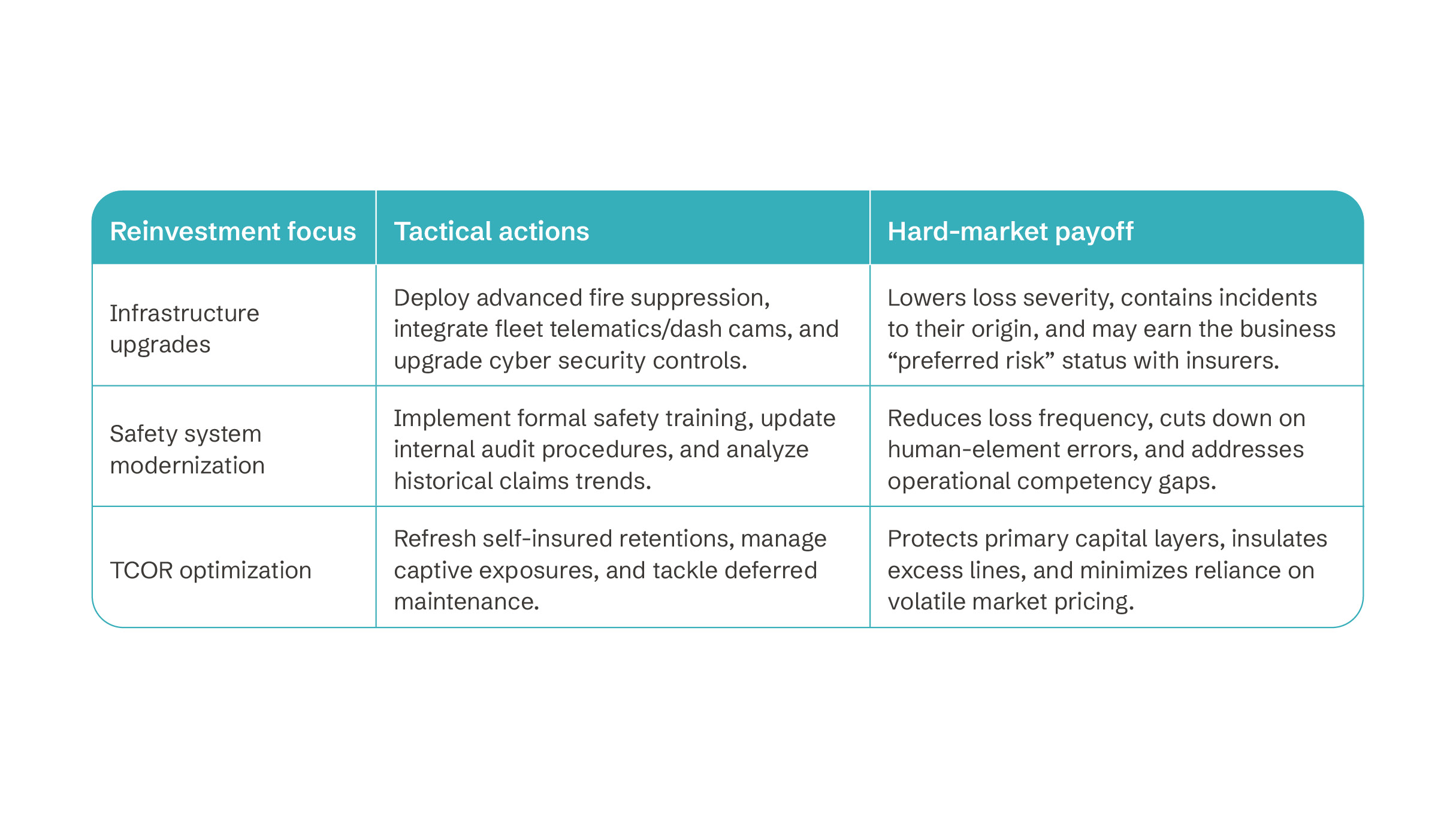
This structural improvement can yield a significant balance-sheet payoff when the market tightens. While physical protections cannot prevent every incident, they can reduce the severity of a loss. For example, a modern, well-maintained fire protection system can help ensure an ignition is contained to its point of origin. Instead of a catastrophic, multi-month operational halt, the resulting business interruption may be limited to minor smoke and water cleanup. For organizations carrying heavy primary retentions, this drop in frequency and severity can insulate both internal capital layers and excess insurance lines from severe financial shocks.
Diagnosing the human element in property preservation
When corporate assets fail, risk managers frequently find themselves in tough conversations with plant and facility managers. In productive industrial environments, operational leads often acknowledge that critical machinery, electrical components, or infrastructure are overdue for lifecycle replacement, but may explain that the necessary capital budgets were withheld to preserve output margins. The surplus cash generated by a soft insurance market can provide the exact liquidity required to break this cycle.
Crucially, forensic engineering data shows that major property losses are rarely driven by unpredictable technical glitches alone; instead, they are often heavily tied to the human element—the behaviours, leadership choices, and risk cultures within an organization.
Common human element exposures include:
- Judgment errors and cognitive bias: Operating under the assumption that because a catastrophic event has never occurred at a facility, it never will.
- Deficient operational culture: A tone at the top that prioritizes volume and immediate productivity metrics over safety margins and scheduled preventative maintenance.
- Competency and training gaps: High employee turnover coupled with inadequate onboarding, leaving workers unable to recognize operational hazards or handle sprinkler impairments safely.
- Workplace fatigue and complacency: High workloads that cause personnel to cut corners, such as converting temporary extension cords into permanent wiring solutions.
Overcoming these cultural liabilities requires a deliberate pivot toward meticulous housekeeping, strict dust control in high-exposure environments like woodworking, and stringent hot-work permitting protocols. Ensuring that facilities are backed by detailed emergency planning and routine drills changes the underlying risk profile in ways that a standard insurance transaction cannot match.
Accessing specialized risk engineering expertise
If you’d like to take advantage of current market conditions, there is support available. Aviva Canada provides commercial clients with direct access to a dedicated professional bench of risk engineers through Aviva Risk Management Solutions (ARMS) and Risk Engineering and Advisory Services (REAS). These field specialists partner with our clients’ managers to deliver comprehensive facility audits, diagnose hidden operational vulnerabilities, and provide actionable remediation pathways.
Aviva’s Specialist Partner Network also connects you with a pre-vetted registry of external, independent, and reputable service providers specialized in execution-level risk reduction. Whether an organization needs to deploy advanced water mitigation controls, install automated fire suppression infrastructure, or execute localized structural fire hardening, these technical resources give corporate decision-makers the tools needed to leverage soft market savings today, protecting corporate margins before the next hard market arrives.