
When business leaders plan for worst-case scenarios, they often focus on high-tech threats or shifting economic cycles. Yet one of the most immediate dangers to keeping a company open remains a very traditional problem: property fires.
Data from Aviva Canada’s Global Corporate & Specialty (GCS) division shows that major commercial property fires happen more often than many corporate risk models may predict. And many causes can be prevented if an organization has the right risk mitigation strategies in place.
Here are some of the leading causes of fire losses and steps your organization can take to prevent or mitigate your risk.
Fire loss trends
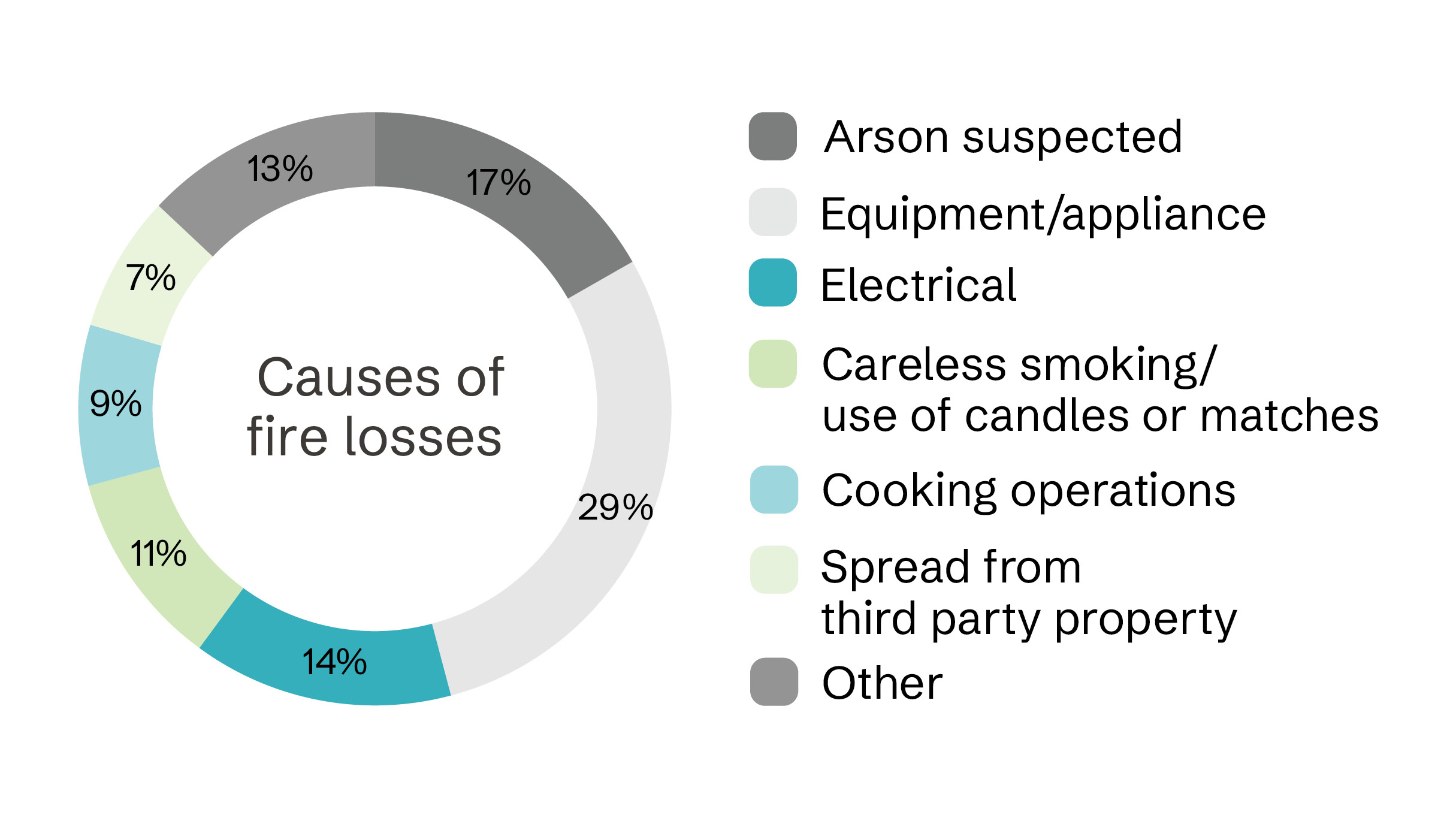
Source: Aviva GCS commercial property fire loss data, based on analysis of large commercial fire losses within the GCS portfolio from 2024 to 2025.
Preventative maintenance essential for equipment and appliances
As the source of 29% of all commercial fires, mechanical equipment and appliances require vigilance in any building. True prevention means understanding the engineered lifespan of equipment, replacing parts before they fail, and keeping spare components on hand to avoid compounding supply chain delays.
Origin of fires
Lithium batteries
- Charging lithium batteries
- Construction site – power tools with lithium batteries
- Lithium battery for e-bikes
Ceiling fans
- Ceiling fan in motel bathroom
- Condo Corp attic fan › Mobile home – dust & lint accumulated in ceiling fan
Space heaters
- Electric baseboard heater
- Ceiling heater installed too close to ceiling
- Heater cable shorted
- Portable heaters
- Heating table
- Radian ceiling heater
Electrical faults
- Frayed wires
- Transformer
- Dehumidifier
- Wall / electric socket
- Fridge electrical components
- Rodents
- Malfunction to temperature gauge
- Dryer
To manage specific hazards within this category, Aviva’s risk engineering teams recommend localized mitigation strategies.
Apply lithium-ion battery controls
Because lithium batteries can fail via thermal runaway—a chemical reaction that autogenerates its own heat and oxygen—standard fire suppression powders and water may be ineffective at stopping the reaction once it begins inside the battery cell envelope. To manage this exposure on construction sites or in mega-warehouses, businesses must isolate charging zones away from other high-value combustible materials.
Facilities should also install early smoke detection paired with automated fan extraction systems. Similar to systems used in commercial parking structures to manage emissions, these configurations automatically vent toxic smoke outside the building, preventing closed-loop smoke damage from migrating through the property while keeping the thermal damage contained.
Maintain commercial and industrial fans
Fires frequently originate in ventilation and ceiling fans when dust and lint are allowed to accumulate, creating a short-circuit hazard. In industrial applications like woodworking, dust extraction systems must strictly meet regulatory codes to keep the environment safe. Similarly, fans connected to industrial cooking, baking, and oven processes must be thoroughly cleaned and inspected at least annually to ensure grease and heat mixtures do not ignite inside the ductwork.
Service space and unit heaters regularly
Suspended warehouse unit heaters powered by propane, natural gas, or electricity must be professionally serviced once a year before the winter heating season begins. Heating equipment must also match its environment—installing a standard unit heater near flammable fuels or spray applications creates an explosive environment.
On construction sites, teams must actively check for product recalls on temporary unit heaters, ensuring manufacturer safety modifications are in place to prevent malfunctions.
Harden infrastructure against electrical faults
According to Aviva’s data, electrical fires account for 14% of commercial property losses, and they are frequently caused by fried wires. This can happen when equipment demands more energy than the electrical system is engineered to handle, overdemanding the circuit breakers.
To help prevent these infrastructure faults, facility managers should deploy best practices:
- Eliminate permanent extension cords: Extension cords are strictly meant for temporary use with a single piece of equipment. In commercial field audits, underwriters frequently find extension cords installed permanently. Standard cords often lack the proper gauge for permanent operations and are not designed to be dust-, water-, or solvent-proof.
- Verify high-temperature interlocks: High- exposure operations involving dryers—such as wood transformation kilns or food spray dryers for powdered milk—are highly prone to fires. These systems require functioning interlock systems and high-temperature limit switches that automatically activate if the equipment overheats. These safety switches must be regularly tested, as a defective gauge can lead to a rapid fire.
- Maintain rodent control: Pests entering commercial buildings frequently chew through electrical wiring insulation, triggering short circuits and hidden fires behind walls. Routine pest management can help reduce this risk.
How to defend your assets against arson and careless smoking
According to Aviva’s data, suspected arson is behind up to 17% of large commercial fire losses. Realty and hospitality businesses stand out as the most frequent targets. Careless smoking and the misuse of matches or candles are the cause of another 11% of fires.
Defending against intentional fires requires companies to look beyond basic municipal building codes and incorporate:
- 24/7 sprinkler monitoring: Aviva risk professionals frequently recommend that corporate clients implement remote monitoring of all internal sprinkler control valves through a certified third-party security firm. This helps ensure that any unauthorized system tampering or closed valves are quickly detected.
- Third-party oversight and hot work permits: Fire protection systems should be regularly inspected by independent third parties. And facilities must enforce strict supervisory sign-offs on hot work permits, ensuring mandatory follow-up checks are conducted after the work is completed.
- Designated smoking zones: To reduce the 11% of losses tied to careless smoking, particularly in residential buildings, condos should implement no smoking policies on the premises—even private balconies. Designate a smoking space 30 feet from the building.
Create a fire-resistant safety culture
Ultimately, the success of these physical controls depends on an organization’s internal safety culture. When forensic engineers investigate major fires, they often find that human behaviour, leadership decisions, and cognitive biases—such as assuming a fire will never happen because it hasn’t happened yet—are contributors.
When assessing a commercial risk, Aviva’s underwriters will analyze management’s overall attitude toward prevention. Underwriting discipline evaluates whether leadership allocates dedicated capital budgets for preventative maintenance, or if high staff turnover has created critical competency and safety training gaps.
To help companies navigate these exposures, Aviva Canada provides commercial clients with direct access to a professional technical bench of risk engineers who can walk managers through a comprehensive facility audit, alongside a suite of self-serve safety resources available online.
Resources
- Aviva Risk Management Solutions (ARMS) news and insights: Get the latest information on commercial risk mitigation strategies, trends, and best practices.
- Aviva Specialist Partner Network: Manage risk and reduce loss on your property via a pre-vetted list of external, independent, and reputable service providers.
For more information about how to protect your property from fire, reach out to our Aviva Risk Management Solutions team.