

The Canadian construction industry is facing more complexity than ever. Elevated material costs, tight financing conditions, compressed profit margins, and increasing climate volatility are putting pressure on project economics and capital allocation decisions. These challenges can be further compounded by a highly selective, capital-intensive project pipeline and intense delivery pressures.
Meanwhile, demand for infrastructure investment, resilient buildings, and large-scale projects continues to create long-term opportunities for the sector.
At a recent Aviva Construction Exchange event in Toronto, Aviva’s commercial insurance, surety, claims, and corporate risk leaders, along with Insurance Bureau of Canada (IBC) Director of Economics and Financial Policy Tina Liu shared important insights and a comprehensive insurance solution designed for an industry in flux.
Insight: Construction costs remain above broader inflation
Liu reported that non-residential building construction costs have escalated 45% since Q1 2019. This cost pressure can drive up total project values, and expose organizations to underinsurance if asset valuations are not accurately calibrated.
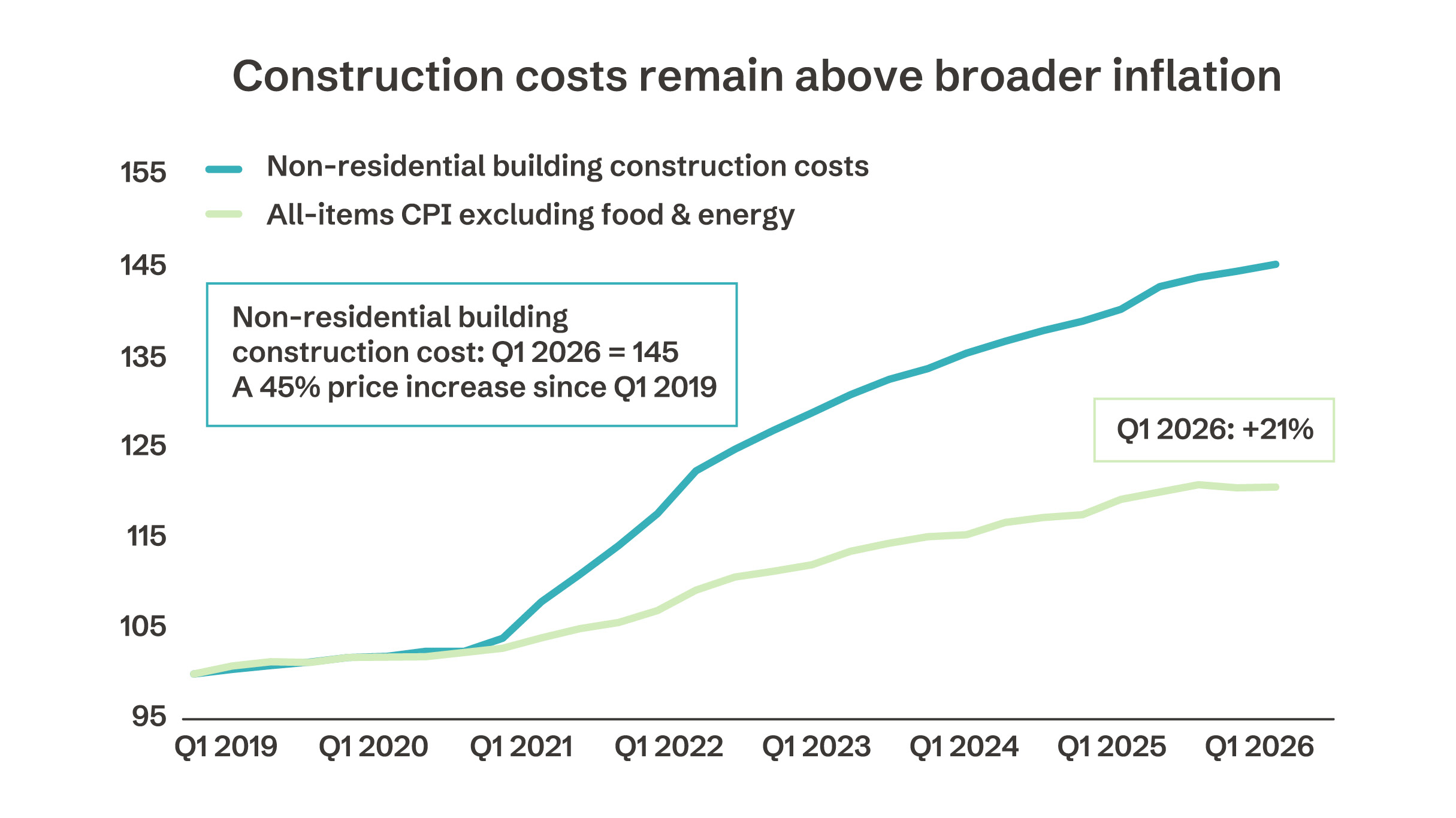
Source: IBC analysis with data from Statistics Canada. Q1 2019 = 100.
Insight: Macro pressures are reshaping construction risk
Materials, labour, and financing costs remain higher, increasing project values and margin pressure.
The IBC analysis reveals material price jumps across supply chains:
- Structural steel framing: Costs have jumped 10.3% year-over-year.
- Metal fabrications: Costs are up 8.6% year-over-year.
- Wood, plastics, and composites: Costs increased 3.3% year-over-year.
- Concrete: Costs rose 2.1% year-over-year.
Insight: Construction activity has diverged across segments
Higher borrowing costs have contributed to slowed residential development, prompting many project owners and general contractors to pivot toward capital-intensive non-residential infrastructure. This shift concentrates higher project values into fewer, more complex builds.
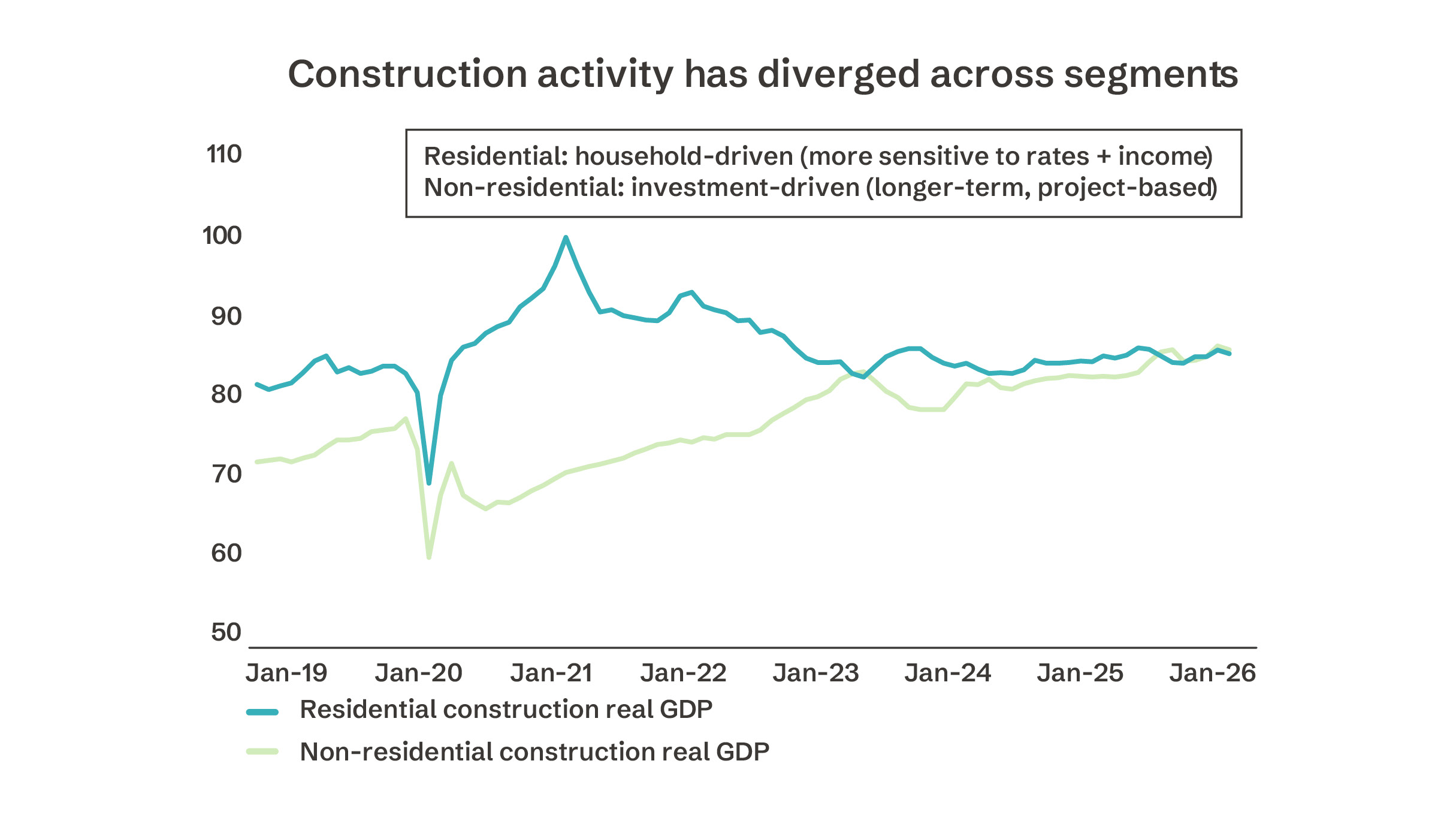
Source: IBC analysis with data from Statistics Canada.
Insight: Natural catastrophe losses are increasing over time
The rising frequency and severity of natural catastrophes are creating significant risk management concerns. In Canada, these losses reached a historic $9.4 billion in 2024. Greater weather volatility can also increase both direct damage and disruption during construction.
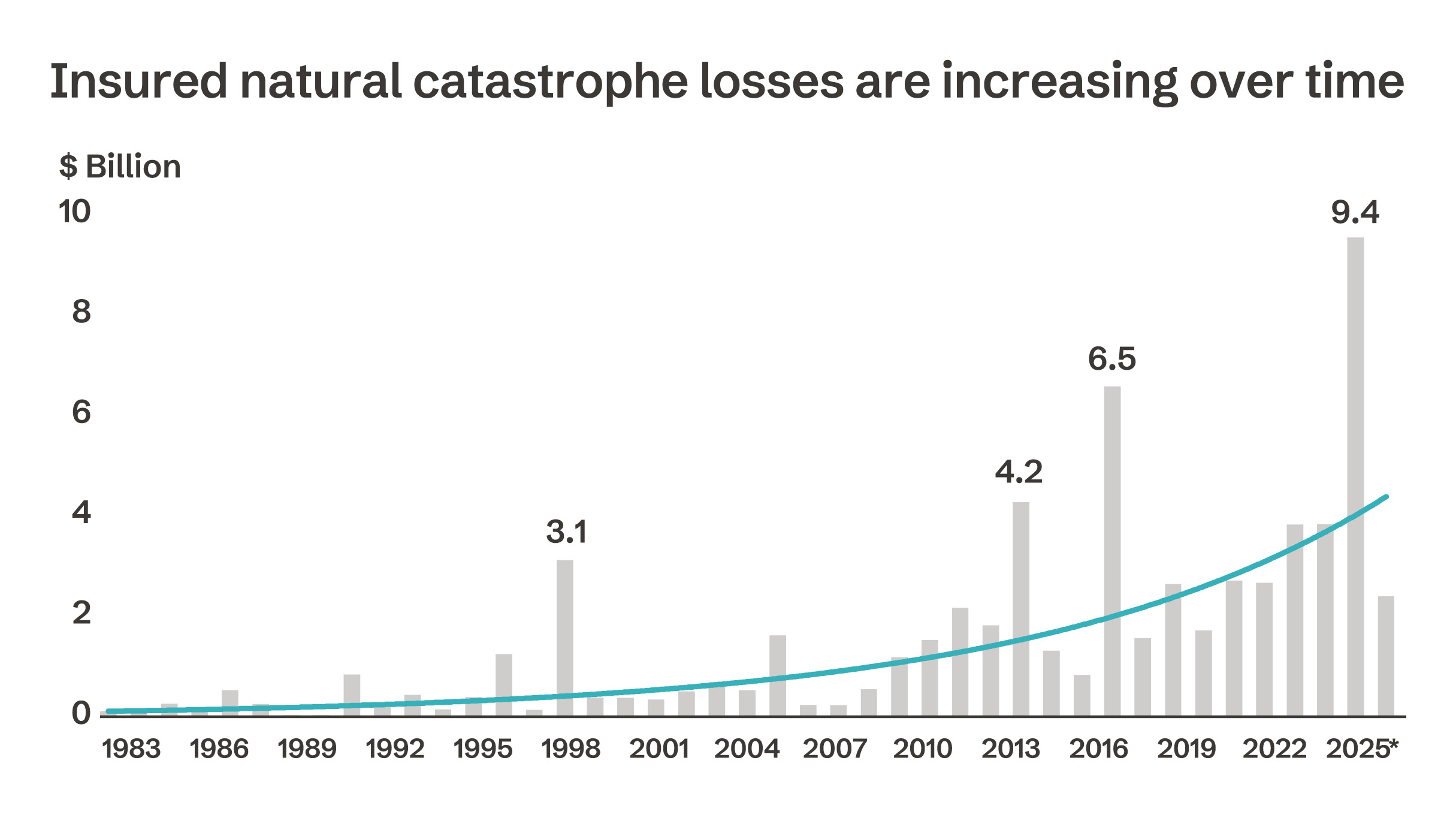
Source: IBC Facts Book, PCS, CatIQ, Swiss Re, Munich Re & Deloitte
Data includes events with insured losses of $25 million or more from 2008 to February 2022; from March 2022 onwards, the threshold is $30 million. Values include loss adjustment expenses and are in 2025 Canadian dollars, 2024* & 2025* values are preliminary.
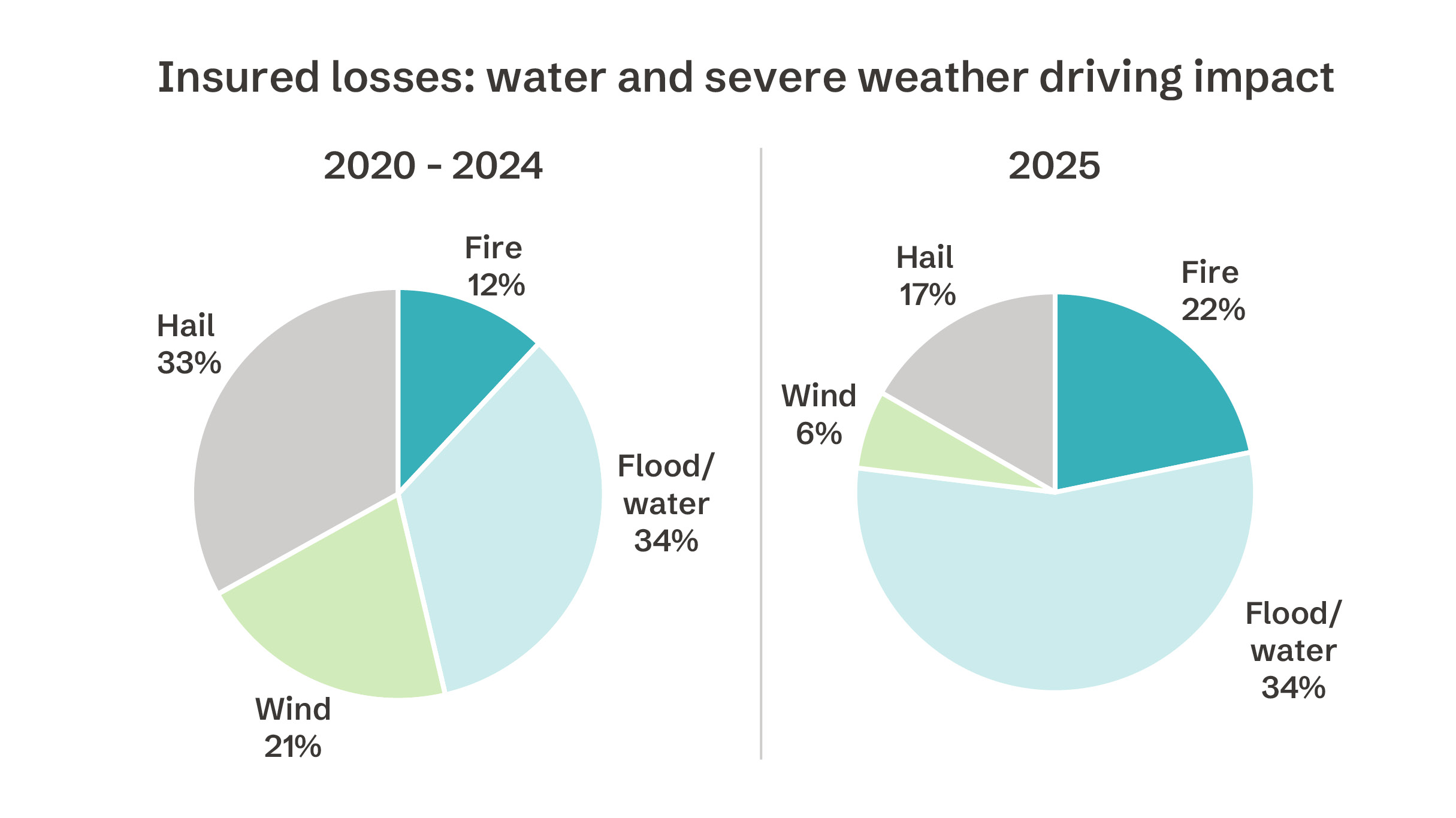
Source: CatIQ. Values include loss adjustment expenses, 2024 and 2025 values are preliminary.
For a major commercial construction project, a catastrophic water escape or fire can cause a cascade of financial losses that may not be fully addressed by traditional builders’ risk coverage. When a project site is compromised, owners can face regulatory shutdowns during investigations, escalated material costs, extended interest on investor loan agreements, and mounting monthly management fees.
"Overall, we see that construction cost longer time. This reality demands a more holistic, adaptable approach to corporate risk management."
- Tina Liu, IBC Director of Economics and Fi ancial Policy
A solution: Aviva Construction
Aviva Canada recognizes the shifting sands in the construction industry and has identified important opportunities to serve our construction clients and brokers. We’ve responded with a structural framework designed to integrate standard builders’ risk and contractors’ insurance with contract and commercial surety capacities under a single, unified underwriting team.
Typically, property underwriting, liability, and contract surety bonds have operated in silos, forcing brokers and risk managers to handle multiple handoffs. This fragmented approach can lead to administrative friction and potential coverage gaps during crucial transition phases.
By managing balance sheet liabilities and completion guarantees simultaneously, Aviva Construction transitions the conversation from transactional placements to portfolio-level risk solutions. If a contractor needs to pivot from residential developments to complex non-residential infrastructure to align with market demand, the unified underwriting team evaluates overall capability and financial resilience collectively, expanding capacity to support the client through shifting economic pressures.
Aligning lifecycles and liquid protections
The Aviva Construction framework tracks a capital project across its entire lifecycle, matching coverage directly to evolving project exposures:
1. Pre-construction and planning: Merging contractor pre-qualification data with risk engineering before breaking ground.
2. Site preparation: Managing initial enabling works and localized environmental liability.
3. Core construction: Deploying Builder’s Risk and Wrap-Up Liability tailored to current material cost baselines. Contract Surety bonds to help mitigate and, if necessary, manage the risk of a defaulting contractor.
4. Fit-out and finishing: Integrating specialized operational risk policies, including Subcontractor Default Insurance (SDI) and project-specific Errors
and Omissions (E&O).
5. Commissioning: Coordinating specialized large- loss claims engineering teams to oversee complex testing and close-out phases.
6. Operational handover: Transitioning the completed physical asset seamlessly into permanent property, casualty, and commercial fleet insurance structures.
Parametric Weather Insurance offers innovative edge
An essential component of this unified approach is the inclusion of Parametric Weather Insurance to protect project cash flow from weather-induced schedule delays. Traditional builders’ risk policies require physical asset damage to trigger a payout, which may leave companies with limited protection against weather-driven delays.
Parametric contracts bypass the traditional adjusting process. They are triggered by verified third-party meteorological parameters—such as rainfall exceeding a specified threshold during a critical concrete pour. Corporate decision-makers will have access to funds, and use them flexibly to cover contract penalty fees, maintain specialized labor crews, or offset extended heavy equipment rental costs.
As the Canadian construction pipeline becomes more selective and capital-intensive, financial and execution resilience are the primary differentiators for success. Structurally aligning risk engineering, contract surety, and property insurance capabilities under one team gives large commercial organizations the stability needed to protect their corporate margins from inception to completion.
To learn more about how Aviva Construction can support your next project, please contact your broker.


