

For renewable energy operators, intermittency has always been a challenge. The sun doesn't always shine, and the wind doesn't always blow when the grid needs power most. Enter Battery Energy Storage Systems (BESS) – a technology that’s no longer niche but a cornerstone of modern renewable infrastructure.
Today, BESS is doing far more than providing back up power. It’s becoming indispensable for utility-scale solar and wind facilities, as well as mid-sized commercial operations looking to maximize the value of their renewable assets. Acting as a buffer, these systems store excess generation and release it when demand, and pricing, peaks. The result? Higher return on investment (ROI) and improved grid stability.
In this blog, we’ll explore:
- Where BESS technology stands today
- Where it’s headed
- The critical risk management strategies you need before investing
The case for BESS: Cutting costs and peak shaving
Two major factors are driving the adoption of BESS in commercial facilities: plummeting costs and grid management.
The price drop
Battery technology is following the same trajectory as solar panels, which were historically prohibitively expensive until prices plummeted. At the battery pack level, prices are roughly 15% of what they were in 2013. As this trend continues, the financial argument for replacing high-maintenance diesel assets with low-maintenance battery systems becomes much stronger.
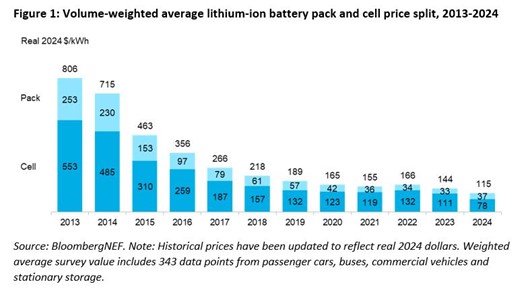
Note: price is in USD
Peak shaving
For industrial customers, particularly in regions like Ontario, BESS offers a unique financial advantage: peak shaving. Utility companies often categorize industrial clients based on their highest hour of power draw. If you spike to 110KW for just one hour, you may be charged a premium rate for every kilowatt you consume.
A BESS would allow you to absorb that peak using stored energy, keeping your draw low and your classification in a cheaper bracket. This not only reduces your energy costs but also supports grid stability by delaying the need for new generation capacity.
The critical control for safety
With new technology comes new risks. Lithium-ion batteries present unique hazards, particularly thermal runaway, a chain reaction that creates intense fires that are difficult to extinguish.
While standard advice often points to compliance with codes like NFPA 855 or UL 9540, our risk consultants have identified specific, practical controls that are often overlooked but vital for safety.
Early detection is everything
The only way to interrupt the process of a battery failing and entering thermal runaway is early detection.
Smoke detectors react too late to prevent battery fires. A better solution is to install combustible gas detectors inside the battery enclosure. When a battery starts failing, it releases gas before catching fire. These detectors can trigger an automatic shutdown, disconnecting the battery and stopping thermal runaway before flames appear.
Physical separation
If a fire does occur, it must be contained. Our ARMS specialists recommend strict physical separation between containers to prevent fire propagation. If one unit fails, it should not take down the entire system or adjacent structures.
Environmental protection
Fighting a battery fire requires immense amounts of water, which can become contaminated with metals and electrolytes. Integrate secondary containment systems, such as berms or retention basins, into your site design to prevent hazardous runoff from entering soil or waterways, mitigating significant environmental liability.
However, resilience requires preparation. Adhering to standards like FM Standard 5-33 and implementing robust detection and containment strategies are essential to protecting your investment.
Aviva Risk Management Solutions is here to help
Our Aviva Risk Management Solutions team can help you manage the complexities of BESS integration, from code compliance to practical safety implementations. Reach out to us at arms.canada@aviva.com to safeguard your renewable energy investment.
Source:
BloombergNEF: Lithium-Ion battery pack prices hit record hit record low of $139/kWh


